Matthew 24:5 and the Question of Punctuation

Over the past few months two different readers have contacted me to ask about the question of punctuation in Matthew 24:5, specifically about the quotation marks usually found there. I have written a fair amount on this blog about the lack of punctuation in Ancient Greek, including quotation marks, and this has spawned a fair amount of discussion. Part of that discussion has taken place off-line since it did not directly address the semantics or syntax of Ancient Greek, but issues of interpretation.
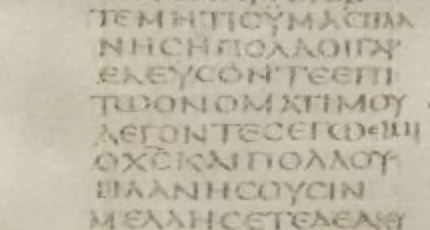
It turns out, though, that this quotation in Matthew 24:5 is a great example of why you need to understand the semantics, syntax, and patterns of usage for Ancient Greek in order to make valid determinations about punctuation.

It is not a matter of deciding where quotation marks could work in English. There are limits on what could count as a quote, and where that quote could start or end imposed by the meanings of the Greek words involved, their grammatical forms, and the wider context of what is being said. 

In this particular case, the text is as follows:

πολλοὶ γὰρ ἐλεύσονται ἐπὶ τῷ ὀνόματί μου λέγοντες
Ἐγώ εἰμι ὁ Χριστός, καὶ πολλοὺς πλανήσουσιν.

The first part is pretty simple: πολλοὶ γὰρ ἐλεύσονται ἐπὶ τῷ ὀνόματί μου (For many will come in my name). The following participle (λέγοντες) introduces what those coming in Jesus’ name will say: Ἐγώ εἰμι ὁ Χριστός. It is the people who say this that will lead many astray (καὶ πολλοὺς πλανήσουσιν).

The two people who inquired about this verse both asked if it could be read without quotation marks altogether, rendering a meaning quite different from what is usually found in published translations. If there is no quote here, so the argument goes, then Ἐγώ could refer to Jesus, and not to the false teachers who he says will come later. That is, they asked if the text could be read as saying 

Many will come in my name saying I am the Messiah, and they will lead many astray.

While this may seem plausible in English, it is not plausible in Greek. In English we can say “Many will come in my name saying I am…” and understand “my” and “I” to refer to the same person. In Greek, though, the form of the statement would likely be quite different if ἐγώ and μου referred to the same person. We would be far more likely to see something like this:

πολλοὶ γὰρ ἐλεύσονται ἐπὶ τῷ ὀνόματί μου λέγοντες
ἐμέ εἰναι τὸν Χριστόν, καὶ πολλοὺς πλανήσουσιν.

That is, if no quotation were involved, the usual wording in Greek would involve expressing the part about who is the Messiah with an infinitival clause, with both its subject and object expressed in the accusative case. 

If Matthew intended us to understand that Jesus was saying the false teachers would acknowledge him as the messiah, he chose an extremely confusing way to say it. His first readers would certainly read what he wrote to mean the false teachers would claim to be the messiah, not that they would acknowledge him in that role.

Despite the lack of punctuation in the Ancient Greek texts, it is problematic to decide about the punctuation of a translation on the basis of what works in English. A familiarity with the structure of Ancient Greek and the usual patterns of expression in that language are essential for making such decisions.

I appreciate the questions posed by readers of my comments on punctuation. While I don’t always have a quick answer, they inevitably send me back to the text to look for the limits and possibilities offered by the ancient authors’ choices of wording.

For further reading on the issue of punctuation in Ancient Greek, see the following posts:

I would like to give a special thank you to Shelia Harrison and Serge Beugels for prompting me to take a fresh look at this passage. Thank you for your curiosity and critical thinking!
Punctuation in Ancient Greek Texts, Part III (Quotations)

Originally published on January 6, 2013

This morning I heard Peter Carman preach on Matthew 2:1-12. He did a super job, striking a great balance between scholarship and pastoral guidance.

As the scriptural text was being read aloud in English, I followed along in my Greek text. [Yes. I am one of those geeks who takes the Greek text to church. I don’t use it to intimidate other worshipers but because I find reading the Greek texts to be a meaningful experience.] As I was reading this text, it hit me that it’s a great example of the problem posed by the lack of clear indication of where quotes begin and end in Ancient Greek.

While it’s usually very easy to see where a quote begins, finding the end of the quote is much more challenging because there was no punctuation, and no grammatical convention, to indicate this. The particular point at which the issue appears in this text is in the priests’ and scribes’ response to Herod when he asks them about where the Christ will be born.

Ηρῴδης . . . συναγαγὼν πάντας τοὺς ἀρχιερεῖς καὶ γραμματεῖς τοῦ λαοῦ ἐπυνθάνετο παρ᾿ αὐτῶν ποῦ ὁ χριστὸς γεννᾶται (verses 3 and 4).

Herod . . . gathering all the high priests and scribes of the people, inquired of them concerning where the Christ would be born.

The clause introducing their response is quite clear:

οἱ δὲ εἶπαν αὐτῷ·. . .

And they said to him: . . .

So it’s not hard to find the beginning of the quote. Where we decide the quote ends, though, has a significant impact on the meaning of the passage. The NRSV, NIV, NET Bible, and TEV all use quotation marks to have the response include all of the following:

ἐν Βηθλέεμ τῆς Ἰουδαίας· οὕτως γὰρ γέγραπται διὰ τοῦ προφήτου· 6 καὶ σὺ Βηθλέεμ, γῆ Ἰούδα, οὐδαμῶς ἐλαχίστη εἶ ἐν τοῖς ἡγεμόσιν Ἰούδα· ἐκ σοῦ γὰρ ἐξελεύσεται ἡγούμενος, ὅστις ποιμανεῖ τὸν λαόν μου τὸν Ἰσραήλ. (verses 5 and 6)

In Bethlehem of Judea, for thus it has been written by the prophet: ‘And you, Bethlehem, in the land of Judah, are by no means least among the rulers of Judah, for from you will come a ruler who is to shepherd my people Israel.”

This interpretive decision is perfectly reasonable, of course, but it is not the only one possible, and it does have significance for what Matthew intended. It asserts that the chief priests and scribes quoted scripture to Herod. While there is no clear reason to think they wouldn’t do this, it’s also not clear that Matthew meant us to understand the text in this way.

Let’s consider another option that is equally well supported by the the text. Suppose Matthew meant only that they answered, ἐν Βηθλέεμ τῆς Ἰουδαίας (in Bethlehem of Judea).

Keep in mind that the raised dot in the printed text further above is an editor’s decision based on evidence that first appeared in the text much later than its date of composition. A period is an equally reasonable interpretation of that same evidence.

If the author of this text intended the quote to include nothing more than ἐν Βηθλέεμ τῆς Ἰουδαίας, then the rest of this section would be his own attempt to explain why they gave this answer.

οὕτως γὰρ γέγραπται διὰ τοῦ προφήτου· 6 καὶ σὺ Βηθλέεμ, γῆ Ἰούδα, οὐδαμῶς ἐλαχίστη εἶ ἐν τοῖς ἡγεμόσιν Ἰούδα· ἐκ σοῦ γὰρ ἐξελεύσεται ἡγούμενος, ὅστις ποιμανεῖ τὸν λαόν μου τὸν Ἰσραήλ.

For thus it has been written by the prophet: “And you, Bethlehem, in the land of Judah, are by no means least among the rulers of Judah; for from you shall come a ruler who is to shepherd my people Israel.” 

In this reading of the text, the scriptural quote does not represent something the high priests and scribes said to Herod, but something the author quoted to his readers to show the significance of the answer given by the high priests and scribes to Herod’s question.

I apologize to Peter for thinking about this while he was delivering his insightful sermon this morning. While he didn’t discuss the punctuation of the text, he did make me think a lot about the text’s significance for today’s church. For that I thank him seriously.

Here’s a little reflection on why we should care about the punctuation:

Punctuation matters. When I mentioned this issue to my 16-year-old daughter earlier this afternoon, she responded, “Of course punctuation matters. ‘Let’s eat, Grandma’ doesn’t mean the same as ‘Let’s eat Grandma.'” She’s right, of course. It matters.

For a competent reader of Ancient Greek to fail to question the punctuation in our printed editions of the Ancient Greek texts is an abdication of a significant part of our responsibility. If we don’t struggle with the punctuation, we are simply handing that responsibility off to the editors of those texts. While that is a reasonable thing for students early in the study of the language to do, it is not a reasonable thing for accomplished readers to do. Question the punctuation. Struggle with it. Ask how the text would change if we punctuated it differently. What options are reasonable? Which ones are not? This is a part of what it means to read seriously.

Here are some other posts dealing with the lack of punctuation in Ancient Greek:

There is also one tangentially related topic that arose out of this discussion earlier:

Happy reading!

Important! [Added Jan. 19, 2015]:

While the earliest manuscripts of the biblical texts did not contain punctuation, it is usually clear to a competent reader of Ancient Greek where the punctuation belongs.

It is a serious mistake to assume that the absence of punctuation in those manuscripts means a person who does not read Greek is free to choose where to put the punctuation in an English translation. To make decisions about where the punctuation belongs, it is necessary to read Ancient Greek very well. Many options that would seem to be available in an English text are ruled out by the structure of the Greek text.

Punctuation in Ancient Greek Texts, Part II

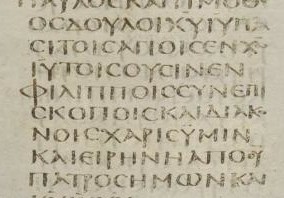
Philippians 1:1-2 in Codex Sinaiticus

Here is a good example of what I had to say in my last post about the lack of punctuation in Ancient Greek, including the absence of spaces between words. The image is from Codex Sinaiticus, Philippians 1:1-2.

Here is the same text with spaces added between the words:

ΠΑΥΛΟΣ  ΚΑΙ  ΤΙΜΟΘΕΟΣ  ΔΟΥΛΟΙ ΧΥ  ΙΥ  ΠΑΣΙΝ  ΤΟΙΣ  ΑΓΙΟΙΣ  ΕΝ  ΧΥ  ΙΥ ΤΟΙΣ  ΟΥΣΙΝ  ΕΝ  ΦΙΛΙΠΠΟΙΣ  ΣΥΝ  ΕΠΙΣΚΟΠΟΙΣ  ΚΑΙ  ΔΙΑΚΟΝΟΙΣ  ΧΑΡΙΣ  ΥΜΙΝ  ΚΑΙ  ΕΙΡΗΝΥ  ΑΠΟ  ΘΥ  ΠΑΤΡΟΣ  ΗΜΩΝ  ΚΑΙ  ΚΥ  ΙΥ  ΧΥ

Notice in addition to the lack of punctuation and spacing, the regular use of abbreviations for the words God (ΘΕΟΥ = ΘΥ), Lord (ΚΥΡΙΟΥ = ΚΥ), Jesus (ΙΗΣΟΥ = ΙΥ), and Christ (ΧΡΙΣΤΟΥ = ΧΥ). In Codex Sinaiticus as in all of the early manuscripts, such abbreviations are marked by a macron (¯) over the letters. I was not able to do that when I typed out the version with the spaces above. By including both the first and last letters in the abbreviation, the CASE of the words in question is clear (Genitive in this context for all of them), so even the abbreviations present minimal difficulty for a reasonably fluent reader of Hellenistic Greek.

To see the earlier discussion, go here:

On January 6, 2013 I added a third post on the topic of punctuation:

Important! [Added Jan. 19, 2015]

While the earliest manuscripts of the biblical texts did not contain punctuation, it is usually clear to a competent reader of Ancient Greek where the punctuation belongs.

It is a serious mistake to assume that the absence of punctuation in those manuscripts means a person who does not read Greek is free to choose where to put the punctuation in an English translation. To make decisions about where the punctuation belongs it is necessary to read Ancient Greek very well. Many options that would seem to be available in an English text are ruled out by the structure of the Greek text.

Punctuation in Ancient Greek Texts, Part I

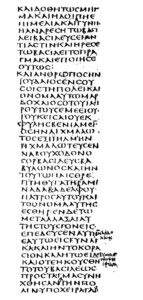
Esther 2:3-8 in Codex Sinaiticus

Originally published on December 27, 2010: Punctuation in Ancient Greek

Recognizing that readers of this blog represent various levels of competence in reading Ancient Greek and levels of familiarity with Hellenistic Greek texts, I am posting an email I wrote to a user of  Greek-Language.com back in 2005 in response to the question, “Did Ancient Greek use punctuation?” If you already know the answer to that question, just skip this post! (Or better yet, comment!)

On Mon, August 29, 2005 I wrote regarding punctuation in Ancient Greek:

Dear _________:

Thank you for your letter. Your question is an interesting and important one, and we have considerable evidence with which to answer it.

The ancient Greeks did not have any equivalent to our modern device of punctuation. Sentence punctuation was invented several centuries after the time of Christ. The oldest copies of both the Greek New Testament and the Hebrew Old Testament are written with no punctuation.

In addition, the ancient Greeks used no spaces between words or paragraphs. Texts were a continuous string of letters, with an occasional blank line inserted to mark the end of a major section, though even this was not always done.

They also had no equivalent to our lower case letters. Texts were written in all capitals.

While this clearly creates some challenges for Bible translation, those challenge are seldom very large. As a simple test, try reading the English text in the following line:

WHATDOESTHISSAY

With very little difficulty you can probably tell where the spaces should be and what kind of punctuation belongs at the end. You can tell this because you are a native speaker of the language in which the text is written, so you can easily recognize the words as well as the implication of the word order. Native speakers of Ancient Greek, in the same way, could recognize where one word ended and another began even though the spaces were not written. They could also distinguish a question from a direct statement without the need of punctuation.

Here’s the real problem: You and I are NOT native speakers of Ancient Greek.

While I read Ancient Greek quite well, I did not grow up speaking it. All modern scholars, including those who grew up speaking Modern Greek, are in this same situation.

When there is more than one possible way of dividing the words in a sentence or paragraph, or when there is more than one possible set of punctuation, we must look for clues as to what the author intended in order to correctly determine which is the correct division and what punctuation the author would have used if it had been available.

Of course there is an element of subjectivity in this process, but many scholars have dedicated the better part of their lives to reading the Biblical documents in the original languages and have come to have a good sense of the style and preferences of each author. As we develop this skill, it becomes easier to see what the author would most likely have intended in each of the few places where a sentence could be divided more than one way.

If you do not read Ancient Greek and Hebrew, it is important to compare various translations to see what the options for punctuation might be. Then you should ask yourself which punctuation results in something that the author would most likely have said. This may not always provide you with the correct answer, but it will be a valuable learning experience.

Thank you again for your letter. I wish you well in your studies.

Micheal W. Palmer

Greek Language and Linguistics Gateway

http://greek-language.com


A few years later, I posted two other discussions of punctuation in Ancient Greek. You can find them by following the links below:

Another topic tangentially related to this one is available here: Usage of καί.

Important! [Added Jan. 19, 2015]

While the earliest manuscripts of the biblical texts did not contain punctuation, it is usually clear to a competent reader of Ancient Greek where the punctuation belongs.

It is a serious mistake to assume that the absence of punctuation in those manuscripts means a person who does not read Greek is free to choose where to put the punctuation in an English translation. To make decisions about where the punctuation belongs it is necessary to read Ancient Greek very well. Many options that would seem to be available in an English text are ruled out by the structure of the Greek text.

Punctuation in Ancient Greek Texts, Part II

Here is a good example of what I had to say in my last post about the lack of punctuation and spacing in Ancient Greek. The image is from Codex Sinaiticus, Philippians 1:1-2.

Philippians 1:1-2 in Codex Sinaiticus

Here is the same text with spaces added between the words:
ΠΑΥΛΟΣ  ΚΑΙ  ΤΙΜΟΘΕΟΣ  ΔΟΥΛΟΙ ΧΥ  ΙΥ  ΠΑΣΙΝ  ΤΟΙΣ  ΑΓΙΟΙΣ  ΕΝ  ΧΥ  ΙΥ  ΤΟΙΣ  ΟΥΣΙΝ  ΕΝ  ΦΙΛΙΠΠΟΙΣ  ΣΥΝ  ΕΠΙΣΚΟΠΟΙΣ  ΚΑΙ  ΔΙΑΚΟΝΟΙΣ  ΧΑΡΙΣ  ΥΜΙΝ  ΚΑΙ  ΕΙΡΗΝΥ  ΑΠΟ  ΘΥ  ΠΑΤΡΟΣ  ΗΜΩΝ  ΚΑΙ  ΚΥ  ΙΥ  ΧΥ

Notice in addition to the lack of punctuation and spacing, the regular use of abbreviations for the words God (ΘΕΟΥ - ΘΥ), Lord (ΚΥΡΙΟΥ – ΚΥ), Jesus (ΙΗΣΟΥ – ΙΥ), and Christ (ΧΡΙΣΤΟΥ – ΧΥ). In Codex Sinaiticus as in all of the early manuscripts, such abbreviations are marked by a macron (¯) over the letters. I was not able to do that when I typed out the version with the spaces above. By including both the first and last letters in the abbreviation, the CASE of the words in question is clear (Genitive in this context for all of them), so even the abbreviations present minimal difficulty for a reasonably fluent reader of Hellenistic Greek.

To see the earlier discussion, go here:

On January 6, 2013 I added a third post on the topic of punctuation:

Important! [Added Jan. 19, 2015]
While the earliest manuscripts of the biblical texts did not contain punctuation, it is usually clear to a competent reader of Ancient Greek where the punctuation belongs.

It is a serious mistake to assume that the absence of punctuation in those manuscripts means a person who does not read Greek is free to choose where to put the punctuation in an English translation. To make decisions about where the punctuation belongs it is necessary to read Ancient Greek very well. Many options that would seem to be available in an English text are ruled out by the structure of the Greek text.

Punctuation in Ancient Greek Texts, Part I

Recognizing that readers of this blog represent various levels of competence in reading Ancient Greek and levels of familiarity with Hellenistic Greek texts, I am posting an email I wrote to a user of Greek-Language.com back in 2005 in response to the question, “Did Ancient Greek use punctuation?” If you already know the answer to that question, just skip this post! (Or better yet, comment!)

On Mon, August 29, 2005 I wrote:

Dear __________:

Thank you for your letter. Your question is an interesting and important one, and we have considerable evidence with which to answer it.

The ancient Greeks did not have any equivalent to our modern device of punctuation. Sentence punctuation was invented several centuries after the time of Christ. The oldest copies of both the Greek New Testament and the Hebrew Old Testament are written with no punctuation.

In addition, the ancient Greeks used no spaces between words or paragraphs. Texts were a continuous string of letters, with an occasional blank line inserted to mark the end of a major section, though even this was not always done.

They also had no equivalent to our lower case letters. Texts were written in all capitals.

While this clearly creates some challenges for Bible translation, those challenge are seldom very large. As a simple test, try reading the English text in the following line:

WHATDOESTHISSAY

With very little difficulty you can probably tell where the spaces should be and what kind of punctuation belongs at the end. You can tell this because you are a native speaker of the language in which the text is written, so you can easily recognize the words as well as the implication of the word order. Native speakers of Ancient Greek, in the same way, could recognize where one word ended and another began even though the spaces were not written. They could also distinguish a question from a direct statement without the need of punctuation.

Here’s the real problem: You and I are NOT native speakers of Ancient Greek.

While I read Ancient Greek quite well, I did not grow up speaking it. All modern scholars, including those who grew up speaking Modern Greek, are in this same situation.

When there is more than one possible way of dividing the words in a sentence or paragraph, or when there is more than one possible set of punctuation, we must look for clues as to what the author intended in order to correctly determine which is the correct division and what punctuation the author would have used if it had been available.

Of course there is an element of subjectivity in this process, but many scholars have dedicated the better part of their lives to reading the Biblical documents in the original languages and have come to have a good sense of the style and preferences of each author. As we develop this skill, it becomes easier to see what the author would most likely have intended in each of the few places where a sentence could be divided more than one way.

If you do not read Ancient Greek and Hebrew, it is important to compare various translations to see what the options for punctuation might be. Then you should ask yourself which punctuation results in something that the author would most likely have said. This may not always provide you with the correct answer, but it will be a valuable learning experience.

Thank you again for your letter. I wish you well in your studies.

Micheal W. Palmer
Greek Language and Linguistics Gateway
http://greek-language.com


Since the writing of this post on December 27, 2010, two other discussions of the lack of punctuation in Ancient Greek have been posted. You can find them by following the links below:

Another topic tangentially related to this one is available here:


Important! [Added Jan. 19, 2015]
While the earliest manuscripts of the biblical texts did not contain punctuation, it is usually clear to a competent reader of Ancient Greek where the punctuation belongs.

It is a serious mistake to assume that the absence of punctuation in those manuscripts means a person who does not read Greek is free to choose where to put the punctuation in an English translation. To make decisions about where the punctuation belongs it is necessary to read Ancient Greek very well. Many options that would seem to be available in an English text are ruled out by the structure of the Greek text.